10 Sustainable House Construction Materials in Bangalore (2026 Guide)
Bangalore’s construction boom is colliding with a hard reality: the city can’t keep building the way it did 20 years ago. Water tables are dropping, river sand mining is restricted, and buyers are asking sharper questions about what’s actually inside their walls. At YV Homes, every material on this list has come up in real client conversations — not as theory, but as line items in actual cost sheets and site visits across North Bangalore. Here are 10 sustainable materials reshaping home construction in the city, what each one actually costs you (and saves you), and where it fits into a real build.
1. AAC Blocks (Autoclaved Aerated Concrete)
Best for: Walls that need to breathe AAC blocks are now the default wall material for most quality builds in Bangalore, and for good reason — they’re roughly a third of the weight of red clay bricks, cut cooling costs by improving insulation, and go up faster on site. YV Homes uses AAC blocks as standard on most residential projects for exactly this reason: lower structural load, faster timelines, better thermal comfort.
2. M-Sand (Manufactured Sand)
Best for: Consistent, eco-compliant concrete With river sand mining tightly regulated around Bangalore, M-Sand has become the practical and legal standard. It’s manufactured to a consistent particle size, which actually improves concrete workability compared to variable river sand — a quality control win, not just an environmental one.
3. Precast Concrete Panels
Best for: Speed without compromising strength Panels cast off-site and assembled on-site cut construction time significantly and reduce on-site waste and dust — a real consideration for sites in dense residential layouts where neighbors notice every extra week of construction noise.
4. Recycled Steel
Best for: Structural framing with a lower footprint. Recycled steel skips the energy-intensive ore-mining process entirely while matching the strength and durability of virgin steel. For RCC framing and reinforcement, it’s a straightforward swap with no performance trade-off.
5. Solar Roof Tiles
Best for: Turning your roof into a utility bill reducer. Rather than bolting panels onto a roof, solar tiles integrate directly into the roofing structure — producing power while maintaining a cleaner architectural line. For Bangalore’s near year-round sun, this is increasingly a request YV Homes fields directly from clients planning long-term ownership.
6. Rammed Earth Walls
Best for: Natural insulation with a striking finish. Compacted earth walls offer excellent thermal mass — staying cool through Bangalore’s warm months without mechanical cooling — while giving interiors a distinctive, textured look that plastered walls can’t replicate.
7. Reclaimed Wood
Best for: Character features without new timber demand. Sourced from old structures rather than fresh-cut timber, reclaimed wood works well for accent elements — door frames, ceiling beams, feature walls — where character matters as much as sustainability.
8. Hempcrete
Best for: Lightweight, breathable insulation. A newer entrant to the Indian market, hempcrete is carbon-negative, naturally mould-resistant, and fire-resistant — a strong option for insulation-focused applications as availability improves regionally.
9. Cork Flooring & Insulation
Best for: Sound-dampening, allergy-friendly interiors. Harvested without felling the tree, cork is renewable, biodegradable, and naturally hypoallergenic — a practical choice for bedrooms and home offices where sound insulation and air quality both matter.
10. Green Roofs & Living Walls
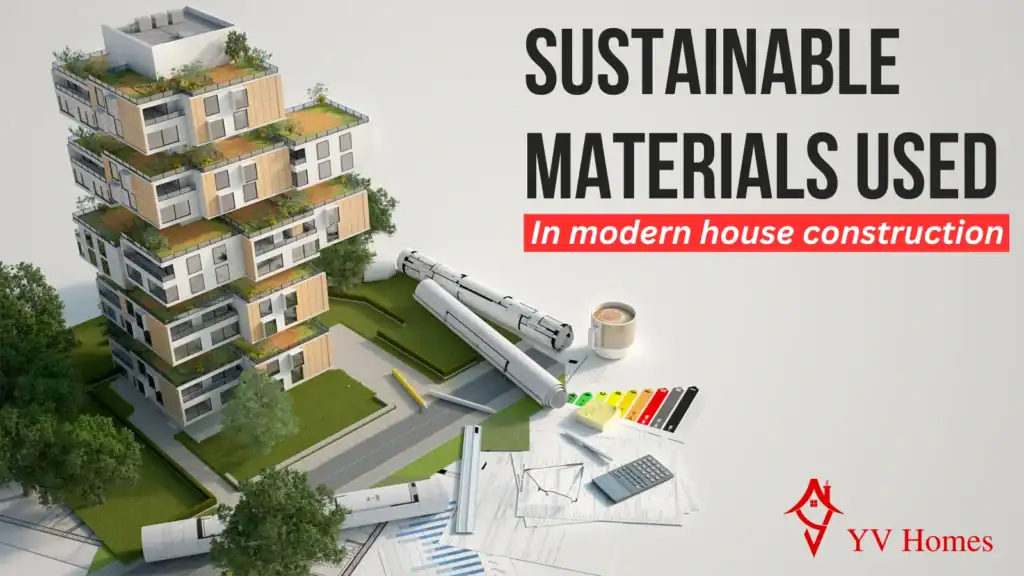
Best for: Cutting urban heat and adding usable green space Beyond aesthetics, planted roofs and walls measurably reduce indoor heat gain and improve air quality — a genuinely useful feature for Bangalore’s shrinking green cover, and a differentiator YV Homes increasingly designs in on request.
Quick Comparison: Cost vs. Long-Term Value
| Material | Upfront Cost | Long-Term Value | Best Use |
|---|---|---|---|
| AAC Blocks | Low-Medium | High | Walls |
| M-Sand | Low | Medium | Concrete/Plaster |
| Precast Panels | Medium | High | Fast-track builds |
| Recycled Steel | Medium | High | Structural framing |
| Solar Tiles | High | Very High | Roofing/energy |
| Rammed Earth | Medium-High | High | Feature walls |
| Reclaimed Wood | Medium | Medium | Accents/interiors |
| Hempcrete | High (limited supply) | High | Insulation |
| Cork | Medium | Medium | Flooring |
| Green Roofs | Medium-High | High | Roof/terrace |
Conclusion: Building Smarter, Not Just Greener
Sustainable construction in Bangalore homes isn’t a trend anymore — it’s becoming the practical default, driven as much by water scarcity and sand regulations as by environmental conscience. The good news: you don’t need to choose between sustainability and staying on budget. Materials like AAC blocks and M-Sand already deliver both, while additions like solar tiles or rammed earth let you go further when your budget allows. The real skill isn’t knowing this list — it’s knowing which combination makes sense for your site, soil, and budget. That’s where a build partner who works with these materials daily, not just writes about them, makes the difference.
Planning a build in Bangalore? Talk to the YV Homes team about which sustainable materials fit your site and budget — we’ll walk you through real cost comparisons, not just brochure claims.
FAQ
AAC blocks currently offer the best balance of low upfront cost, faster construction timelines, and long-term energy savings, which is why they’re the standard choice across most YV Homes projects.
Some materials carry a higher upfront cost, but savings on cooling, maintenance, and water use typically offset this within a few years of occupancy — particularly with AAC blocks, M-Sand, and solar tiles.
Materials with strong thermal mass — AAC blocks and rammed earth in particular — perform well in Bangalore’s moderate but increasingly warm climate by reducing dependence on active cooling.
AAC blocks and M-Sand are standard across YV Homes builds; features like solar tiles, green roofs, and rammed earth are available as design additions based on client budget and site conditions.
Look forward to smart materials, 3D-printed homes, and even bio-engineered living structures that merge nature and architecture.